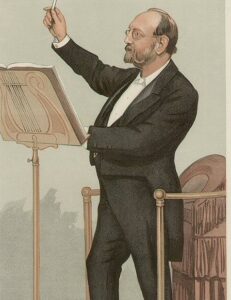
The Royal Albert Hall Choral Society was founded in 1871 to fill the cavernous spaces of the vast new hall. Under Joseph Barnby, the massive amateur choir became a cornerstone of the London concert calendar, leading to royal patronage and a change of name (to the Royal Choral Society) in 1888.
Under Barnby and (from 1896) Frederick Bridge, the 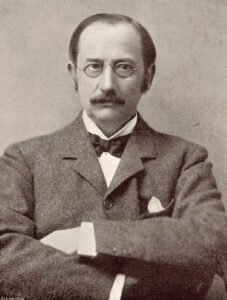 society promoted up to 10 concerts a year, favouring the full sonorities of large-scale oratorios. Programming settled into a regular pattern with an opening Elijah, Messiah around New Year’s Day, a work of religious meditation on AshWednesday, and Messiah again on Good Friday.
Size was a selling point (advertisements typically boast ‘Chorus and Orchestra, One Thousand’), and delicate precision was hardly a priority, given the hall’s notoriously resonant acoustics. But the society was sensitive to developments in historical performance practice: in 1899 they excised Mozart’s Messiah accompaniments that had held sway across the previous century.
Conservative programming was a recurrent object of criticism. In reality, Elijah and Messiah performances were the financial rock on which the society depended, allowing it to reach out every season to new compositions. But despite financial assistance from the publisher Novello, these usually resulted in substantial losses: only Elgar’s The Dream of Gerontius and Coleridge-Taylor’s The Song of Hiawatha found a regular place in the repertoire.
The society’s archive is held by the London Archives at ACC/2370 (see the archive summary). Although committee minutes are not extant for this period, the archive does contain a complete set of programmes, as well as record sheets and financial accounts relating to individual concerts. The formal annual accounts at ACC/2370/063 give a substantial picture of the society’s operations (see the sheet LCS_Finances at the end of the spreadsheet).
Royal Choral Society concerts are listed in the Royal Albert Hall Archive (under Search Our Event History), but the listings are not entirely accurate. See also the society’s official website, which includes a brief history.
For programmes of the concerts 1892–1914, download the Calendar of London Concerts 1893–1914, press the Search Series tab at the bottom of the page, and select Royal Choral Society.
Further reading
Fiona Gibbs, The Royal Albert Hall: A Case Study of an Evolving Cultural Venue (PhD dissertation, Royal College of Music, 2018)
Simona Valeriani, The Royal Albert Hall: Building the Arts and Sciences (Turnhout: Brepols, 2025)